
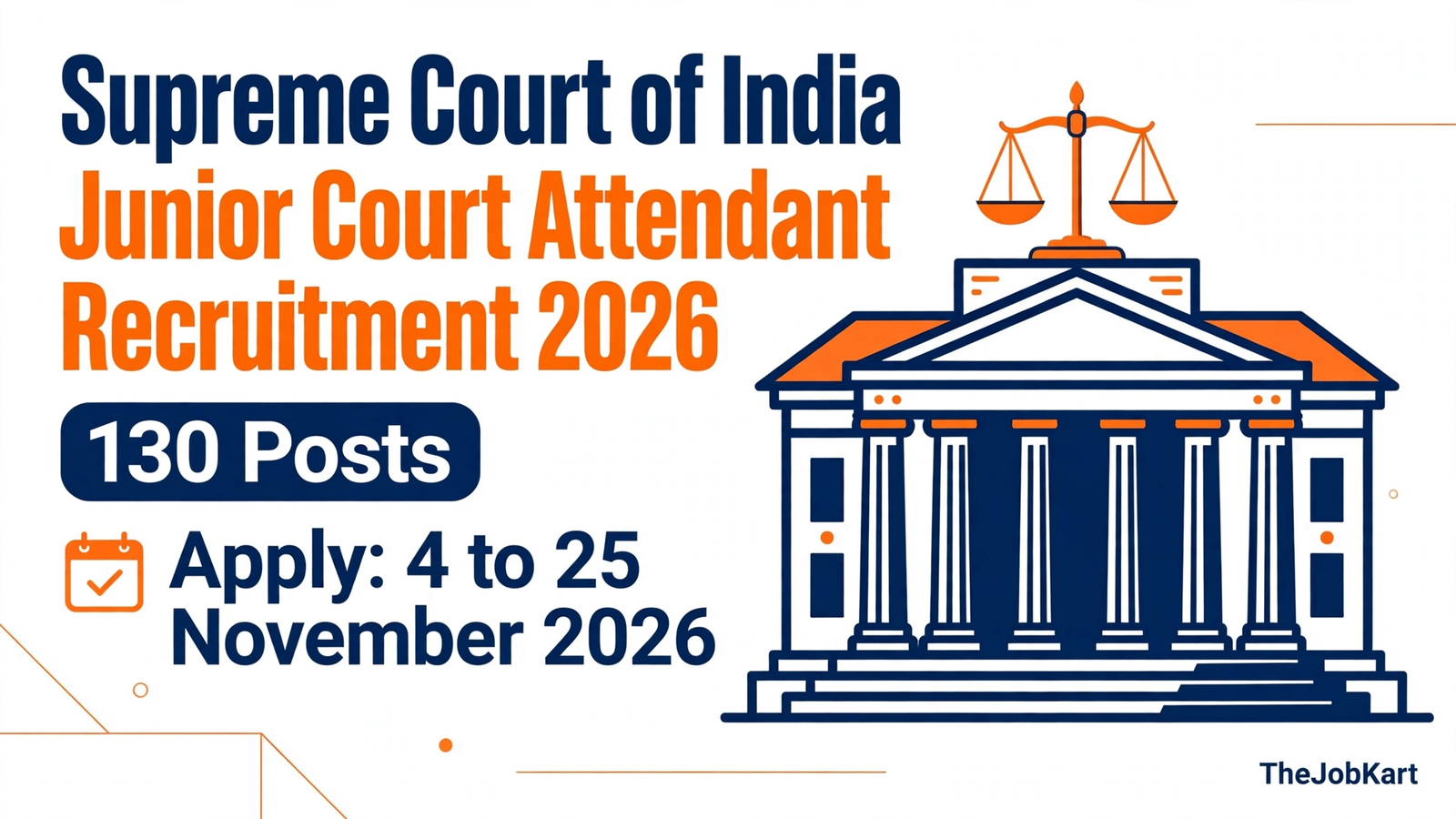
TheJobKart brings you the complete details of the Supreme Court Junior Court Attendant Recruitment 2026. The Supreme Court of India has invited online applications for 130 tentative Junior Court Attendant posts in its Registry in New Delhi, and this is a good opening for young candidates who have passed Class 10 or Class 12 and want a regular Group C job in the country’s highest court.
There is one condition in this recruitment that every applicant must read twice. The qualification is not just a minimum — it is also a maximum. You need at least Class 10, and at most Class 12. Candidates with a higher degree are outside the printed eligibility for this post, so this drive is aimed squarely at school-pass candidates, not graduates.
Applications do not open immediately. The online form will open on 4 November 2026 and close on 25 November 2026, so use the days before the window opens to get your certificates and documents ready.
Table of Contents
- Supreme Court Junior Court Attendant Recruitment 2026 at a Glance
- Vacancy Details
- Who Can Apply? Eligibility Criteria
- Salary and Benefits
- Important Dates
- Application Fee
- Selection Process and Exam Pattern
- How to Apply Online: Step-by-Step
- Documents to Keep Ready
- About the Supreme Court of India
- What Does a Junior Court Attendant Do?
- Why This Recruitment Stands Out
- Frequently Asked Questions
- Important Links
- Disclaimer
Supreme Court Junior Court Attendant Recruitment 2026 at a Glance
| Details | Information |
|---|---|
| Organisation | Supreme Court of India, Recruitment Cell |
| Post name | Junior Court Attendant (JCA) |
| Post group | Group C, Non-Clerical |
| Advertisement number | F.3/2026-SC (RC) |
| Notification date | 15 October 2026 |
| Total vacancies | 130 (tentative) |
| Job type | Regular government service |
| Job location | Supreme Court Registry, New Delhi |
| Educational qualification | Minimum Class 10, maximum Class 12 (10+2) |
| Age limit | 18 to 27 years as on 1 October 2026 |
| Application mode | Online only |
| Application starts | 4 November 2026 |
| Last date to apply | 25 November 2026, up to 11:55 PM |
| Objective-type test (tentative) | 26 December 2026 |
| Answer key upload (tentative) | 28 December 2026 |
| Answer key objection window (tentative) | 28 to 29 December 2026, up to 11:55 PM |
| Pay level | Level 3 of the Pay Matrix |
| Salary | Rs. 21,700 to Rs. 69,100 per month, plus allowances |
| Official website | sci.gov.in |
The number of posts is described as tentative, which means the Registry can revise it if administrative requirements change. Candidates should therefore treat 130 as the figure announced for now, and check the official notice for any update.
Vacancy Details
There is only one post in this recruitment drive, but it carries a substantial number of openings for a single support role in the court.
| Post | Vacancies |
|---|---|
| Junior Court Attendant (Group C, Non-Clerical) | 130 (tentative) |
No category-wise vacancy breakup is printed in the advertisement for this post. Reservation benefits are available in accordance with Rule 4A of the Supreme Court Officers and Servants (Conditions of Service and Conduct) Rules, 1961, and the detailed provisions are set out in the official notification.
Do not confuse this recruitment with two other Supreme Court drives that are running around the same time. The Senior Personal Assistant recruitment, with 65 posts, is a separate Group B post with a degree and shorthand requirement. A separate Court Master recruitment, with 20 posts, is also different. This post is only about the 130 Junior Court Attendant posts under Advertisement No. F.3/2026-SC (RC).
Who Can Apply? Eligibility Criteria
Educational qualification
You need to have passed:
- At least the Class 10 (X Standard) examination, and
- At most the Class 12 (XII Standard / 10+2) examination,
from a board or institute recognised by the government. All eligibility conditions are counted as on 1 October 2026.
This upper limit matters. If you already hold a degree higher than Class 12, you are not eligible under the printed conditions for this post, even if you meet every other requirement. Candidates who have passed Class 10 or Class 12, and no higher qualification, are the intended applicants here.
Age limit
- Minimum age: 18 years
- Maximum age: 27 years
- Age counted as on: 1 October 2026
In practical terms, a candidate who has already completed 28 years as on 1 October 2026 is outside the general age limit, while a candidate aged 26 on that date is inside it, before relaxations are considered.
Age relaxation is available under Government of India rules for SC, ST, OBC (Non-Creamy Layer), physically challenged candidates and ex-servicemen. Dependants of freedom fighters get relaxation of up to five years over and above the prescribed upper age limit. Widows, divorced women and women judicially separated from their husbands who have not remarried are allowed up to 35 years, with 38 years for OBC (Non-Creamy Layer) and 40 years for SC and ST candidates. Departmental candidates of the Supreme Court Registry have no upper age limit.
On the other hand, candidates working in other government departments, public sector undertakings, statutory bodies or nationalised banks get no age relaxation under this notification.
Citizenship and other conditions
Applicants must be Indian citizens. Admission to the test and interview is provisional, and eligibility will be checked in detail at a later stage. Candidates working in central or state government departments, public sector undertakings, statutory bodies or nationalised banks must produce a No Objection Certificate from their employer at the time of document verification.
Salary and Benefits
Selected candidates will be placed in Level 3 of the Pay Matrix, with a pay range of Rs. 21,700 to Rs. 69,100 per month. The starting basic pay is Rs. 21,700, and allowances admissible under the rules will be added to it.
The notification does not print a fixed in-hand figure, because the actual take-home pay depends on the dearness allowance rate and the house rent allowance classification applicable at the time of joining. For a Group C post in New Delhi, however, the combination of basic pay plus central government allowances makes this a stable and sought-after entry-level court job.
Important Dates
| Event | Date |
|---|---|
| Notification released | 15 October 2026 |
| Online application begins | 4 November 2026 |
| Last date to apply | 25 November 2026, up to 11:55 PM |
| Objective-type test (tentative) | 26 December 2026 |
| Answer key upload (tentative) | 28 December 2026 |
| Answer key objection window (tentative) | 28 to 29 December 2026, up to 11:55 PM |
| Interview | To be notified later on sci.gov.in |
Do not look for a live application link before 4 November 2026. The link will be provided on the Supreme Court website from that date. Once the form opens, do not wait until the last evening either — a failed payment or an upload problem on the final day is difficult to resolve in time.
Application Fee
| Category | Fee |
|---|---|
| General / Unreserved | Rs. 1,500 plus bank charges |
| SC / ST / OBC (Non-Creamy Layer) / Ex-Servicemen / Physically Challenged | Rs. 750 plus bank charges |
The fee is non-refundable under any circumstances. Payment must be made online only, through the UCO Bank payment gateway provided on the application link. No postal form and no other mode of payment is accepted.
A separate fee of Rs. 100 per objection applies if you wish to raise an objection against the answer key. That fee is refunded only if the objection is found valid.
Selection Process and Exam Pattern
Selection has two stages, in this order:
- Objective-type test — a multiple-choice test of 100 marks.
- Interview — carrying 25 marks.
Objective-type test
| Section | Questions | Marks |
|---|---|---|
| General Intelligence and Reasoning | 25 | 25 |
| Numerical Aptitude | 25 | 25 |
| General English | 25 | 25 |
| General Awareness | 25 | 25 |
| Total | 100 | 100 |
- Duration: 1 hour 30 minutes
- Each question carries one mark
- Negative marking: 0.25 marks for each incorrect answer
- Minimum qualifying marks: 50 out of 100
If a large number of candidates secure 50 or more marks, candidates are called for interview in the ratio of 1:3 against the number of tentative vacancies, in order of merit.
Interview
- Maximum marks: 25
- Minimum qualifying marks: 13
Candidates who qualify in both stages are empanelled in order of merit. Placement on the panel does not itself guarantee appointment — appointment is made from the panel subject to the Registry’s requirements and available vacancies.
The interview is held either online or in physical mode in Delhi, as notified later. Admit cards will not be sent by post; candidates must download them from sci.gov.in when released. No travelling allowance or daily allowance is payable for appearing in the test or interview.
How to Apply Online: Step-by-Step
- From 4 November 2026, visit the official Supreme Court of India website, sci.gov.in, and open the Recruitment link for Junior Court Attendant.
- Read the detailed advertisement, F.3/2026-SC (RC), in full before you start filling the form.
- Register with a valid email ID and mobile number, and keep them active, because updates are communicated by SMS and email.
- Fill in your personal details and educational details carefully. Your name, father’s name, mother’s name and date of birth must match your Class 10 certificate exactly.
- Select your preferred test cities, in order of preference, from the list in Annexure-A of the advertisement. The Registry may shift centres or change the number of centres depending on the applications received.
- Upload your recent photograph, signature, Class 10 certificate, Class 12 certificate if applicable, caste or community certificate if claiming reservation, and disability certificate if applicable, in the prescribed format and size.
- Pay the application fee online through the UCO Bank gateway for your category.
- Preview the complete form once before submitting. An application once submitted cannot be withdrawn or modified, and the category filled in the form cannot be changed later.
- Submit the form and download or print the filled form for your records. Do not send any hard copy to the Registry.
- Keep your application number safe. You will need it to download the admit card and to check later updates.
If you submit more than one application, only the last submitted form will be considered by the Registry.
Documents to Keep Ready
- Class 10 certificate
- Class 12 certificate, if applicable
- Recent passport-size photograph and scanned signature
- Valid photo identity proof
- Caste or community certificate and non-creamy layer certificate, if claiming reservation
- Disability certificate, if applicable
- No Objection Certificate from your employer, if you work in a central or state government department, public sector undertaking, statutory body or nationalised bank — to be produced at document verification
Candidates with a disability who need a scribe must use the prescribed appendix forms and produce supporting documents at the examination and at verification, as given in the notification.
Original documents will be checked at a later stage, so the details you enter in the form should match them exactly. Any change in name or date of birth requires a Gazette notification, as given in the advertisement.
About the Supreme Court of India
The Supreme Court is the highest judicial authority in India and sits in New Delhi. Its Registry handles the administrative and judicial support work that keeps cases moving — filing, listing, record-keeping, correspondence and assistance to judges and officers.
A Junior Court Attendant works in that support system. It is a service-oriented, hands-on role, and it is an entry point into central government service for candidates who have finished school and want to work in a formal, disciplined institution.
What Does a Junior Court Attendant Do?
Apart from other duties assigned by the Registry, a Junior Court Attendant is required to:
- Carry files, paper books, books and records
- Dust tables, chairs, almirahs, windows, book-shelves and other furniture
- Serve tea, coffee, snacks, water and other refreshments to officers and officials of the Registry
Candidates should apply with a clear understanding of these duties. This is not a clerical or computer-based post. It is a physical, service-oriented support role, and comfort with that kind of work is part of being a good fit for it.
Why This Recruitment Stands Out
Many central government jobs for school-pass candidates are for a small number of posts, or they require a trade certificate. This one offers 130 posts in a single drive, in one of the most respected institutions in the country, with a regular Group C pay scale.
At the same time, the qualification ceiling makes the field narrower than a general Class 10 or Class 12 recruitment. Graduates cannot apply, which means the competition is limited to candidates in the Class 10 to Class 12 band. For those candidates, the combination of 130 posts, a clear two-stage selection process and a December test date makes this a recruitment worth preparing for seriously.
Frequently Asked Questions
What is the last date to apply for Supreme Court Junior Court Attendant Recruitment 2026?
The last date is 25 November 2026, up to 11:55 PM. Applications open on 4 November 2026 and are accepted online only through sci.gov.in.
How many vacancies are there?
There are 130 tentative vacancies for Junior Court Attendant, Group C, Non-Clerical.
What qualification is needed?
A minimum of Class 10 and a maximum of Class 12 (10+2) from a recognised board or institute. Candidates with a higher degree are not eligible under the printed conditions.
What is the age limit?
Candidates should be between 18 and 27 years as on 1 October 2026, with relaxation for eligible categories under government rules.
What is the salary?
The pay is in Level 3 of the Pay Matrix, from Rs. 21,700 to Rs. 69,100 per month, plus allowances. The starting basic pay is Rs. 21,700.
What is the application fee?
Rs. 1,500 for General / Unreserved candidates and Rs. 750 for SC, ST, OBC (Non-Creamy Layer), ex-servicemen and physically challenged candidates, plus bank charges. The fee is non-refundable.
What is the selection process?
An objective-type test of 100 marks, followed by an interview of 25 marks. The minimum qualifying marks are 50 in the test and 13 in the interview.
When is the objective test?
Tentatively on 26 December 2026. The answer key is tentatively due on 28 December 2026, with objections accepted on 28 and 29 December 2026.
Where do I apply?
Through the official Supreme Court website, sci.gov.in, from 4 November 2026. Use only the official portal and avoid third-party application links.
Important Links
- Official website: sci.gov.in
- Recruitment notification: Advertisement No. F.3/2026-SC (RC), dated 15 October 2026, available on sci.gov.in
- Online application: Available on sci.gov.in from 4 November 2026
Disclaimer
This post is written to help candidates understand the recruitment in simple language. It is not a substitute for the official notification. Vacancies, dates, fee, eligibility and selection details are subject to change by the Supreme Court of India, and candidates should verify every detail in the official advertisement before applying. Follow TheJobKart for the latest government and private jobs in India.